# CCS - Claude Code Switch

### The universal AI profile manager for Claude Code.
Run Claude, Gemini, GLM, and any Anthropic-compatible API - concurrently, without conflicts.
[](LICENSE)
[](https://www.npmjs.com/package/@kaitranntt/ccs)
[](https://claudekit.cc?ref=HMNKXOHN)
**[Features & Pricing](https://ccs.kaitran.ca)** | **[Documentation](https://docs.ccs.kaitran.ca)**
## The Three Pillars
| Capability | What It Does | Manage Via |
|------------|--------------|------------|
| **Multiple Claude Accounts** | Run work + personal Claude subs simultaneously | Dashboard |
| **OAuth Providers** | Gemini, Codex, Antigravity - zero API keys needed | Dashboard |
| **API Profiles** | GLM, Kimi, or any Anthropic-compatible API | Dashboard |
## Quick Start
### 1. Install
```bash
npm install -g @kaitranntt/ccs
```
Alternative package managers
```bash
yarn global add @kaitranntt/ccs # yarn
pnpm add -g @kaitranntt/ccs # pnpm (70% less disk space)
bun add -g @kaitranntt/ccs # bun (30x faster)
```
### 2. Open Dashboard
```bash
ccs config
# Opens http://localhost:3000
```
Dashboard updates hub: `http://localhost:3000/updates`
Want to run the dashboard in Docker or pull the prebuilt image? See `docker/README.md`.
### 3. Configure Your Accounts
The dashboard provides visual management for all account types:
- **Claude Accounts**: Isolation-first by default (work, personal, client), with explicit shared context opt-in
- **OAuth Providers**: One-click auth for Gemini, Codex, Antigravity, Kiro, Copilot
- **API Profiles**: Configure GLM, Kimi with your keys
- **Factory Droid**: Track Droid install location and BYOK settings health
- **Updates Center**: Track support rollouts (Droid target, CLIProxy provider changes, WebSearch integrations)
- **Health Monitor**: Real-time status across all profiles
- **Language Switcher**: Toggle dashboard locale between English, Simplified Chinese, and Vietnamese
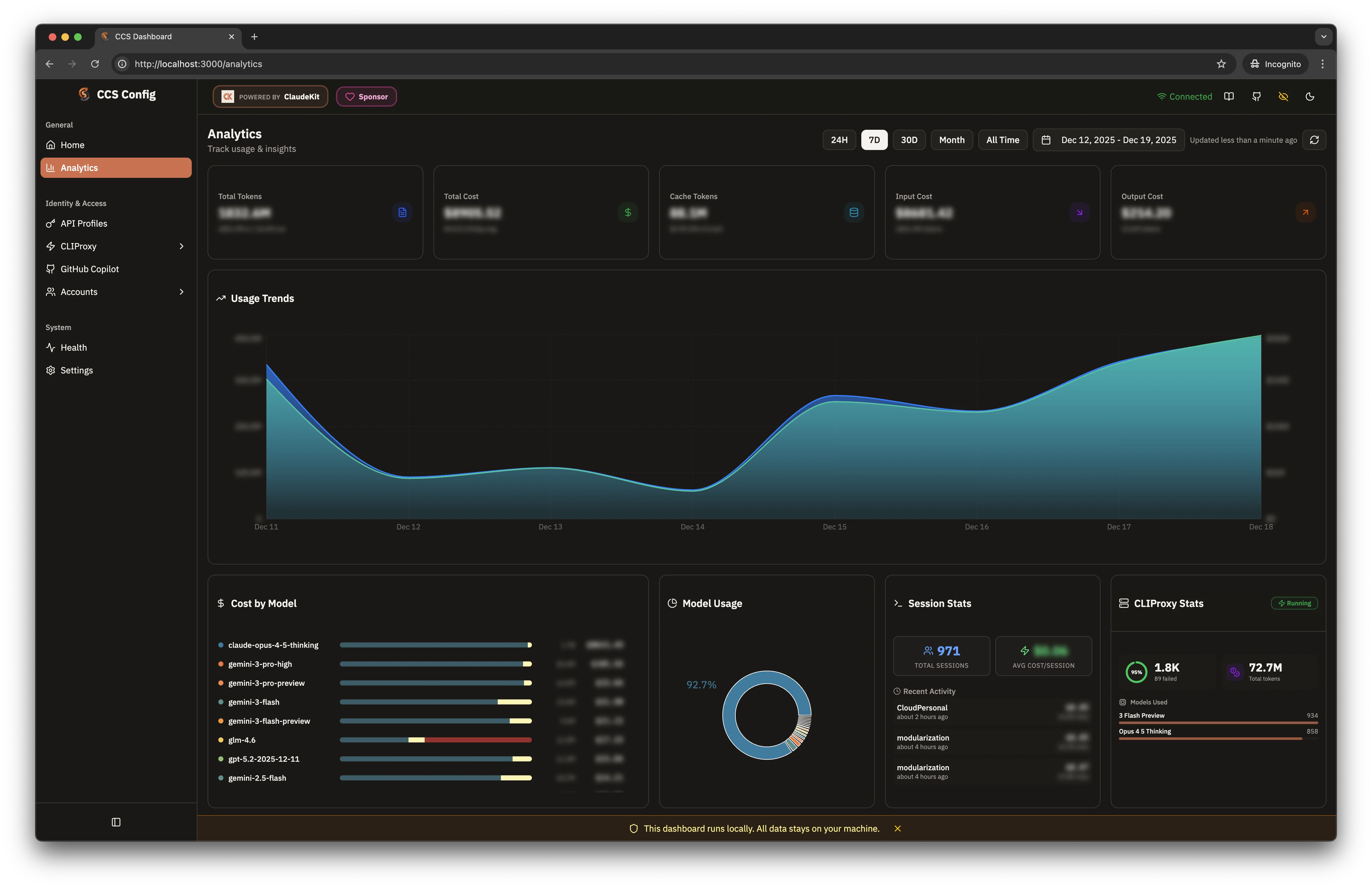
**Analytics Dashboard**
**Live Auth Monitor**

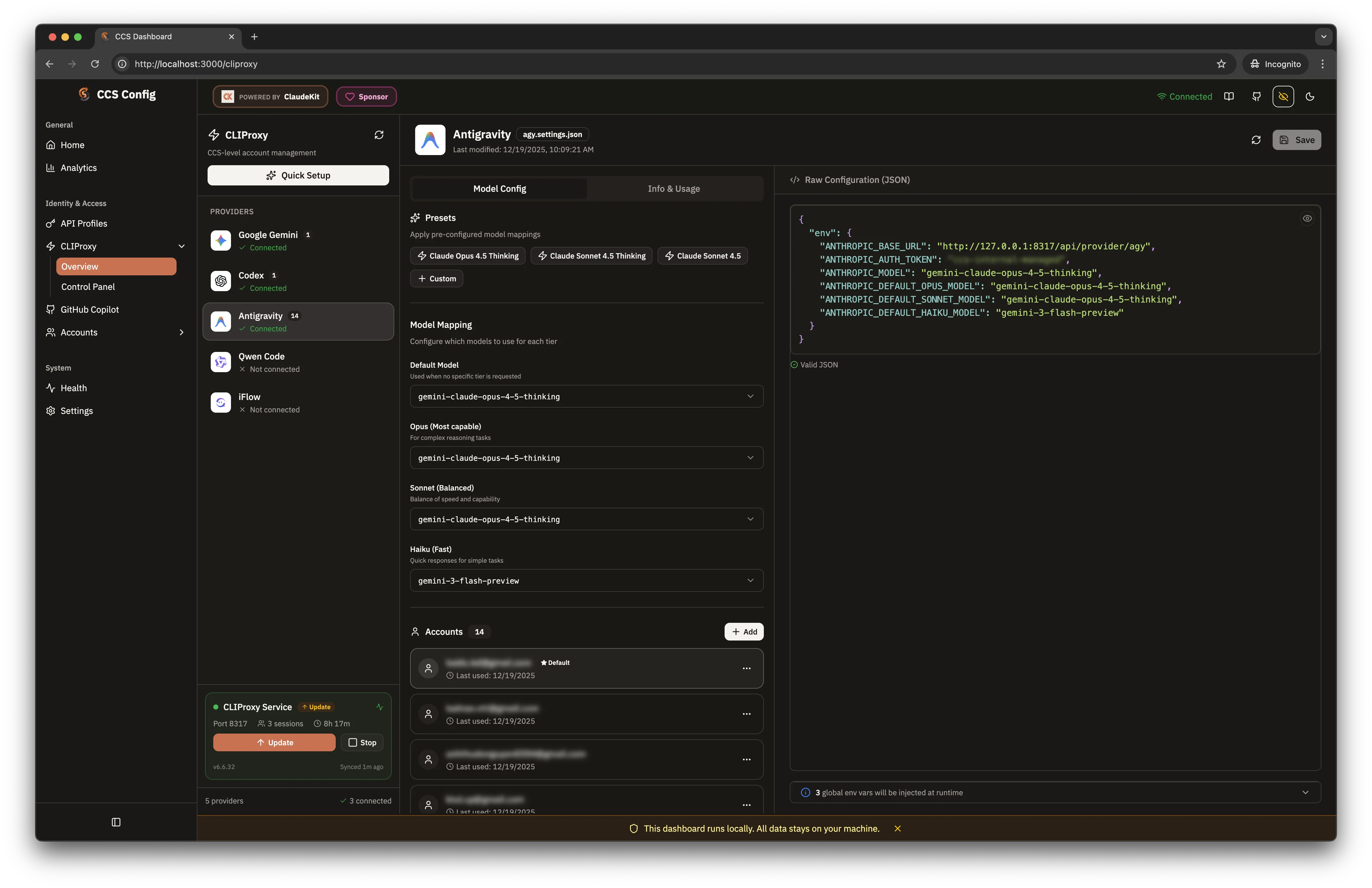
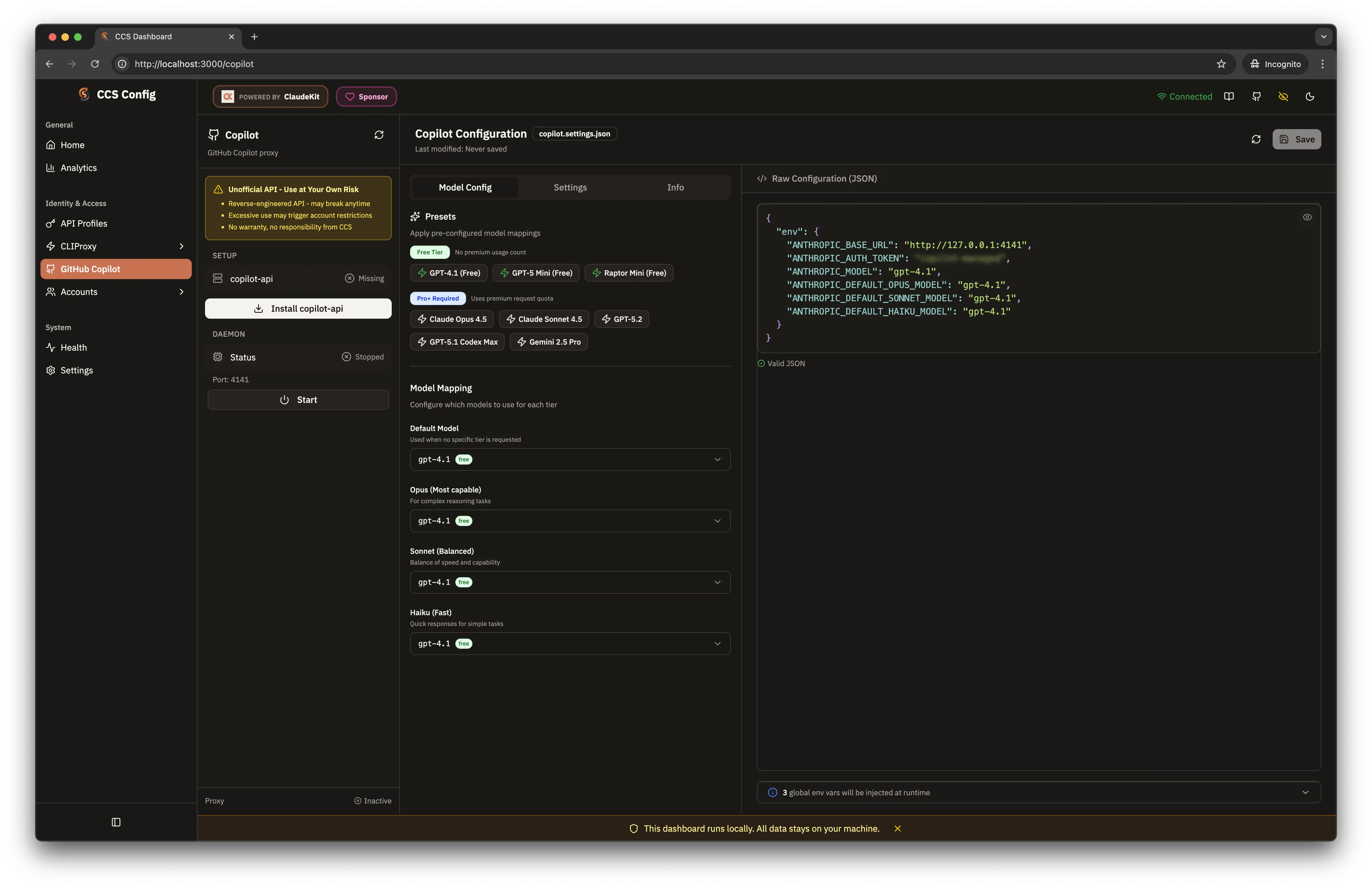
**CLI Proxy API & Copilot Integration**
**WebSearch Fallback**

## Built-in Providers
| Provider | Auth Type | Command | Best For |
|----------|-----------|---------|----------|
| **Claude** | Subscription | `ccs` | Default, strategic planning |
| **Gemini** | OAuth | `ccs gemini` | Zero-config, fast iteration |
| **Codex** | OAuth | `ccs codex` | Code generation |
| **Copilot** | OAuth | `ccs copilot` or `ccs ghcp` | GitHub Copilot models |
| **Cursor IDE** | Local Token | `ccs cursor` | Cursor subscription models via local daemon |
| **Kiro** | OAuth (AWS default) | `ccs kiro` | AWS CodeWhisperer (Claude-powered) |
| **Antigravity** | OAuth | `ccs agy` | Alternative routing |
| **OpenRouter** | API Key | `ccs openrouter` | 300+ models, unified API |
| **Ollama** | Local | `ccs ollama` | Local open-source models, privacy |
| **llama.cpp** | Local | `ccs llamacpp` | Local GGUF inference via llama.cpp server |
| **Ollama Cloud** | API Key | `ccs ollama-cloud` | Cloud-hosted open-source models |
| **GLM** | API Key | `ccs glm` | Cost-optimized execution |
| **KM (Kimi API)** | API Key | `ccs km` | Long-context, thinking mode |
| **Kimi (OAuth)** | OAuth | `ccs kimi` | Device-code OAuth via CLIProxy |
| **Azure Foundry** | API Key | `ccs foundry` | Claude via Microsoft Azure |
| **Minimax** | API Key | `ccs mm` | M2 series, 1M context |
| **DeepSeek** | API Key | `ccs deepseek` | V3.2 and R1 reasoning |
| **Novita AI** | API Key | `ccs api create --preset novita` | Anthropic-compatible Novita endpoint for Claude Code |
| **Qwen (OAuth)** | OAuth | `ccs qwen` | Qwen Code via CLIProxy |
| **Qwen API** | API Key | `ccs api create --preset qwen` | DashScope Anthropic-compatible API |
| **Alibaba Coding Plan** | API Key | `ccs api create --preset alibaba-coding-plan` | Model Studio Coding Plan endpoint |
**OpenRouter Integration** (v7.0.0): CCS v7.0.0 adds OpenRouter with interactive model picker, dynamic discovery, and tier mapping (opus/sonnet/haiku). Create via `ccs api create --preset openrouter` or dashboard.
**Alibaba Coding Plan Integration**: Configure via `ccs api create --preset alibaba-coding-plan` (or preset alias `alibaba`) with Coding Plan keys (`sk-sp-...`) and endpoint `https://coding-intl.dashscope.aliyuncs.com/apps/anthropic`.
**Ollama Integration**: Run local open-source models (qwen3-coder, gpt-oss:20b) with full privacy. Use `ccs api create --preset ollama` - requires [Ollama v0.14.0+](https://ollama.com) installed. For cloud models, use `ccs api create --preset ollama-cloud`.
> **Copilot config behavior:** Opening the dashboard or other read-only Copilot endpoints does not rewrite `~/.ccs/copilot.settings.json`. If CCS detects deprecated Copilot model IDs such as `raptor-mini`, it shows warnings immediately and only persists replacements when you explicitly save the Copilot configuration.
**llama.cpp Integration**: Run a local llama.cpp OpenAI-compatible server and create a profile with `ccs api create --preset llamacpp`. CCS defaults to `http://127.0.0.1:8080`, matching the standard llama.cpp server port.
**Azure Foundry**: Use `ccs api create --preset foundry` to set up Claude via Microsoft Azure AI Foundry. Requires Azure resource and API key from [ai.azure.com](https://ai.azure.com).

> **OAuth providers** authenticate via browser on first run. Tokens are cached in `~/.ccs/cliproxy/auth/`.
**Powered by:**
- [CLIProxyAPIPlus](https://github.com/router-for-me/CLIProxyAPIPlus) - Extended OAuth proxy with Kiro ([@fuko2935](https://github.com/fuko2935), [@Ravens2121](https://github.com/Ravens2121)) and Copilot ([@em4go](https://github.com/em4go)) support
- [CLIProxyAPI](https://github.com/router-for-me/CLIProxyAPI) - Core OAuth proxy for Gemini, Codex, Antigravity
- [copilot-api](https://github.com/ericc-ch/copilot-api) - GitHub Copilot API integration
> [!TIP]
> **Need more?** CCS supports **any Anthropic-compatible API**. Create custom profiles for self-hosted LLMs, enterprise gateways, or alternative providers. See [API Profiles documentation](https://docs.ccs.kaitran.ca/providers/api-profiles).
## Usage
### Basic Commands
```bash
ccs # Default Claude session
ccs gemini # Gemini (OAuth)
ccs codex # OpenAI Codex (OAuth)
ccs cursor # Cursor IDE integration (token import + local daemon)
ccs kiro # Kiro/AWS CodeWhisperer (OAuth)
ccs ghcp # GitHub Copilot (OAuth device flow)
ccs agy # Antigravity (OAuth)
ccs qwen # Qwen Code (OAuth via CLIProxy)
ccs ollama # Local Ollama (no API key needed)
ccs llamacpp # Local llama.cpp (no API key needed)
ccs glm # GLM (API key)
ccs km # Kimi API profile (API key)
ccs api create --preset alibaba-coding-plan # Alibaba Coding Plan profile
ccs api discover --register # Auto-register orphan *.settings.json
ccs api copy glm glm-backup # Duplicate profile config + settings
ccs api export glm --out ./glm.ccs-profile.json # Export for cross-device transfer
ccs api import ./glm.ccs-profile.json # Import exported profile bundle
```
### Droid Alias (`argv[0]` pattern)
By default, invoking CCS as `ccsd` auto-selects the Droid target:
```bash
ln -s "$(command -v ccs)" /usr/local/bin/ccsd
ccsd glm
```
Need additional alias names? Set `CCS_DROID_ALIASES` as a comma-separated list (for example: `CCS_DROID_ALIASES=ccs-droid,mydroid`).
For Factory BYOK compatibility, CCS also stores a per-profile Droid provider hint
(`CCS_DROID_PROVIDER`) using one of:
`anthropic`, `openai`, or `generic-chat-completion-api`.
If the hint is missing, CCS resolves provider from base URL/model at runtime.
CCS also persists Droid's active model selector in `~/.factory/settings.json`
(`model: custom:`). This avoids passing `-m` argv in interactive mode,
which Droid treats as queued prompt text.
CCS supports structural Droid command passthrough after profile selection:
```bash
ccsd codex exec --skip-permissions-unsafe "fix failing tests"
ccsd codex --skip-permissions-unsafe "fix failing tests" # auto-routed to: droid exec ...
ccsd codex -m custom:gpt-5.3-codex "fix failing tests" # short exec flags auto-routed too
```
If you pass exec-only flags without a prompt (for example `--skip-permissions-unsafe`),
Droid `exec` will return its native "No prompt provided" usage guidance.
If multiple reasoning flags are provided in Droid exec mode, CCS keeps the first
flag and warns about duplicates.
Dashboard parity: `ccs config` -> `Factory Droid`
### Per-Profile Target Defaults
You can pin a default target (`claude` or `droid`) per profile:
```bash
# API profile defaults to Droid
ccs api create myglm --preset glm --target droid
# CLIProxy variant defaults to Droid
ccs cliproxy create mycodex --provider codex --target droid
```
Built-in CLIProxy providers also work with Droid alias/target override:
```bash
ccsd codex
ccsd agy
ccs codex --target droid
ccsd codex exec --auto high "triage this bug report"
```
Dashboard parity:
- `ccs config` -> `API Profiles` -> set **Default Target**
- `ccs config` -> `CLIProxy` -> create/edit variant -> set **Default Target**
### Kiro Auth Methods
`ccs kiro --auth` defaults to AWS Builder ID Device OAuth (best support for AWS org accounts).
```bash
ccs kiro --auth --kiro-auth-method aws # AWS Builder ID device code (default)
ccs kiro --auth --kiro-auth-method aws-authcode # AWS Builder ID auth code
ccs kiro --auth --kiro-auth-method google # Google OAuth
ccs kiro --auth --kiro-auth-method github # Dashboard management OAuth flow
```
Dashboard parity: `ccs config` -> Accounts -> Add Kiro account -> choose `Auth Method`.
### Cursor IDE Quick Start
```bash
ccs cursor enable
ccs cursor auth
ccs cursor start
ccs cursor status
```
If auto-detect is unavailable:
```bash
ccs cursor auth --manual --token --machine-id
```
Defaults:
- Port: `20129`
- Ghost mode: enabled
- Dashboard page: `ccs config` -> `Cursor IDE`
Detailed guide: [`docs/cursor-integration.md`](./docs/cursor-integration.md)
### Claude IDE Extension Setup
CCS now has a native setup flow for the Anthropic Claude extension in VS Code and compatible hosts.
Use the same resolver in both the CLI and dashboard, so API profiles, CCS auth accounts,
CLIProxy-backed profiles, Copilot, and default-profile continuity all map to the correct env shape.
Preferred shared-settings path:
```bash
ccs persist glm
ccs persist work
ccs persist default
```
This writes the resolved setup to `~/.claude/settings.json`, which is the best option when you want
the Claude CLI and the IDE extension to share one CCS profile.
IDE-local snippet path:
```bash
ccs env glm --format claude-extension --ide vscode
ccs env work --format claude-extension --ide cursor
ccs env default --format claude-extension --ide windsurf
```
This prints a copy-ready `settings.json` snippet for the installed Claude extension host:
- `vscode` / `cursor`: `claudeCode.environmentVariables` plus `claudeCode.disableLoginPrompt`
- `windsurf`: `claude-code.environmentVariables`
Account and continuity-aware flows use `CLAUDE_CONFIG_DIR` instead of Anthropic transport env vars.
CLIProxy and Copilot flows emit the required `ANTHROPIC_*` variables and still depend on their local
proxy/daemon being reachable.
Dashboard parity:
- `ccs config` -> `Claude Extension`
- Select a CCS profile and IDE host to copy either the shared `~/.claude/settings.json` payload or the IDE-local extension snippet
### Parallel Workflows
Run multiple terminals with different providers:
> Delegation compatibility: when CCS spawns child Claude sessions, it strips the `CLAUDECODE` guard variable to avoid nested-session blocking in Claude Code v2.1.39+.
```bash
# Terminal 1: Planning (Claude Pro)
ccs work "design the authentication system"
# Terminal 2: Execution (GLM - cost optimized)
ccs glm "implement the user service from the plan"
# Terminal 3: Local testing (Ollama - offline, privacy)
ccs ollama "run tests and generate coverage report"
# Terminal 4: Review (Gemini)
ccs gemini "review the implementation for security issues"
```
### Multi-Account Claude
Create isolated Claude instances for work/personal separation:
```bash
ccs auth create work
# Run concurrently in separate terminals
ccs work "implement feature" # Terminal 1
ccs "review code" # Terminal 2 (personal account)
```
#### Account Context Modes (Isolation-First)
Account profiles are isolated by default.
| Mode | Default | Requirements |
|------|---------|--------------|
| `isolated` | Yes | No `context_group` required |
| `shared` | No (explicit opt-in) | Valid non-empty `context_group` |
Shared mode continuity depth:
- `standard` (default): shares project workspace context only
- `deeper` (advanced opt-in): additionally syncs `session-env`, `file-history`, `shell-snapshots`, `todos`
Opt in to shared context when needed:
```bash
# Share context with default group
ccs auth create backup --share-context
# Share context only within named group
ccs auth create backup2 --context-group sprint-a
# Advanced deeper continuity mode (requires shared mode)
ccs auth create backup3 --context-group sprint-a --deeper-continuity
```
Update existing accounts without recreating login:
1. Run `ccs config`
2. Open `Accounts`
3. Click the pencil icon in Actions and set `isolated` or `shared` mode + continuity depth
Shared mode metadata in `~/.ccs/config.yaml`:
```yaml
accounts:
work:
created: "2026-02-24T00:00:00.000Z"
last_used: null
context_mode: "shared"
context_group: "team-alpha"
continuity_mode: "standard"
```
`context_group` rules:
- lowercase letters, numbers, `_`, `-`
- must start with a letter
- max length `64`
- non-empty after normalization
- normalized by trim + lowercase + whitespace collapse (`" Team Alpha "` -> `"team-alpha"`)
Shared context with `standard` depth links project workspace data. `deeper` depth links additional continuity artifacts. Credentials remain isolated per account.
#### Cross-Profile Continuity Inheritance (Claude Target)
You can map non-account profiles (API, CLIProxy, Copilot, or `default`) to reuse continuity artifacts from an account profile:
```yaml
continuity:
inherit_from_account:
glm: pro
gemini: pro
copilot: pro
```
With this config, `ccs glm`, `ccs gemini`, and `ccs copilot` run with `pro`'s `CLAUDE_CONFIG_DIR` continuity context while keeping each profile's own provider credentials/settings.
Alternative path for lower manual switching:
- Use CLIProxy Claude pool (`ccs cliproxy auth claude`) and manage pool behavior in `ccs config` -> `CLIProxy Plus`.
Technical details: [`docs/session-sharing-technical-analysis.md`](docs/session-sharing-technical-analysis.md)
## Maintenance
### Health Check
```bash
ccs doctor
```
Verifies: Claude CLI, config files, symlinks, permissions.
### Update
```bash
ccs update # Update to latest
ccs update --force # Force reinstall
ccs update --beta # Install dev channel
```
### CI Parity Gate (for contributors)
Before opening or updating a PR, run:
```bash
bun run validate:ci-parity
```
This mirrors CI behavior (build + validate + base-branch freshness check) and is also enforced by the local `pre-push` hook.
### Sync Shared Items
```bash
ccs sync
```
Re-creates symlinks for shared commands, skills, and settings.
### Quota Management
```bash
ccs cliproxy doctor # Check quota status for all agy accounts
ccs cliproxy quota # Show agy/claude/codex/gemini/ghcp quotas (Claude/Codex: 5h + weekly reset schedule)
```
**Auto-Failover**: When a managed account runs out of quota, CCS automatically switches to another account with remaining capacity. Shared GCP project accounts are excluded (pooled quota).
### CLIProxy Lifecycle
```bash
ccs cliproxy start # Start CLIProxy background service
ccs cliproxy status # Check running status
ccs cliproxy restart # Restart CLIProxy service
ccs cliproxy stop # Stop running CLIProxy service
```
## Configuration
CCS auto-creates config on install. Dashboard is the recommended way to manage settings.
**Config location**: `~/.ccs/config.yaml`
Custom Claude CLI path
If Claude CLI is installed in a non-standard location:
```bash
export CCS_CLAUDE_PATH="/path/to/claude" # Unix
$env:CCS_CLAUDE_PATH = "D:\Tools\Claude\claude.exe" # Windows
```
CCS sanitizes child Claude spawn environments by stripping `CLAUDECODE` (case-insensitive) to prevent nested-session guard failures during delegation. `CCS_CLAUDE_PATH` is still respected after this sanitization step.
Windows symlink support
Enable Developer Mode for true symlinks:
1. **Settings** → **Privacy & Security** → **For developers**
2. Enable **Developer Mode**
3. Reinstall: `npm install -g @kaitranntt/ccs`
Without Developer Mode, CCS falls back to copying directories.
## WebSearch
Third-party profiles (Gemini, Codex, GLM, etc.) cannot use Anthropic's native WebSearch. CCS automatically provides web search via CLI tools with automatic fallback.
### How It Works
| Profile Type | WebSearch Method |
|--------------|------------------|
| Claude (native) | Anthropic WebSearch API |
| Third-party profiles | CLI Tool Fallback Chain |
### CLI Tool Fallback Chain
CCS intercepts WebSearch requests and routes them through available CLI tools:
| Priority | Tool | Auth | Install |
|----------|------|------|---------|
| 1st | Gemini CLI | OAuth (free) | `npm install -g @google/gemini-cli` |
| 2nd | OpenCode | OAuth (free) | `curl -fsSL https://opencode.ai/install \| bash` |
| 3rd | Grok CLI | API Key | `npm install -g @vibe-kit/grok-cli` |
### Configuration
Configure via dashboard (**Settings** page) or `~/.ccs/config.yaml`:
```yaml
websearch:
enabled: true # Enable/disable (default: true)
gemini:
enabled: true # Use Gemini CLI (default: true)
model: gemini-2.5-flash # Model to use
opencode:
enabled: true # Use OpenCode as fallback
grok:
enabled: false # Requires XAI_API_KEY
```
> [!TIP]
> **Gemini CLI** is recommended - free OAuth authentication with 1000 requests/day. Just run `gemini` once to authenticate via browser.
See [docs/websearch.md](./docs/websearch.md) for detailed configuration and troubleshooting.
## Remote CLIProxy
CCS v7.x supports connecting to remote CLIProxyAPI instances, enabling:
- **Team sharing**: One CLIProxyAPI server for multiple developers
- **Cost optimization**: Centralized API key management
- **Network isolation**: Keep API credentials on a secure server
### Quick Setup
Configure via dashboard (**Settings > CLIProxy Server**) or CLI flags:
```bash
ccs gemini --proxy-host 192.168.1.100 --proxy-port 8317
ccs codex --proxy-host proxy.example.com --proxy-protocol https
```
### CLI Flags
| Flag | Description |
|------|-------------|
| `--proxy-host` | Remote proxy hostname or IP |
| `--proxy-port` | Remote proxy port (default: 8317 for HTTP, 443 for HTTPS) |
| `--proxy-protocol` | `http` or `https` (default: http) |
| `--proxy-auth-token` | Bearer token for authentication |
| `--local-proxy` | Force local mode, ignore remote config |
| `--remote-only` | Fail if remote unreachable (no fallback) |
See [Remote Proxy documentation](https://docs.ccs.kaitran.ca/features/remote-proxy) for detailed setup.
## Standard Fetch Proxy
CCS also respects standard proxy environment variables for fetch-based quota, dashboard,
and provider management requests:
```bash
export HTTPS_PROXY=http://proxy.example.com:8080
export HTTP_PROXY=http://proxy.example.com:8080
export ALL_PROXY=http://proxy.example.com:8080
export NO_PROXY=localhost,127.0.0.1,.internal.corp
```
Notes:
- CCS automatically bypasses loopback addresses (`localhost`, `127.0.0.1`, `::1`) for its own local services.
- If `HTTPS_PROXY` is unset, CCS falls back to `HTTP_PROXY` for HTTPS fetches.
- `ALL_PROXY` is used when protocol-specific proxy variables are not configured.
- Proxy URLs must use `http://` or `https://`.
## Documentation
| Topic | Link |
|-------|------|
| Installation | [docs.ccs.kaitran.ca/getting-started/installation](https://docs.ccs.kaitran.ca/getting-started/installation) |
| Configuration | [docs.ccs.kaitran.ca/getting-started/configuration](https://docs.ccs.kaitran.ca/getting-started/configuration) |
| OAuth Providers | [docs.ccs.kaitran.ca/providers/oauth-providers](https://docs.ccs.kaitran.ca/providers/oauth-providers) |
| Multi-Account Claude | [docs.ccs.kaitran.ca/providers/claude-accounts](https://docs.ccs.kaitran.ca/providers/claude-accounts) |
| API Profiles | [docs.ccs.kaitran.ca/providers/api-profiles](https://docs.ccs.kaitran.ca/providers/api-profiles) |
| Remote Proxy | [docs.ccs.kaitran.ca/features/remote-proxy](https://docs.ccs.kaitran.ca/features/remote-proxy) |
| Cursor IDE (local guide) | [./docs/cursor-integration.md](./docs/cursor-integration.md) |
| Dashboard i18n (local guide) | [./docs/i18n-dashboard.md](./docs/i18n-dashboard.md) |
| CLI Reference | [docs.ccs.kaitran.ca/reference/cli-commands](https://docs.ccs.kaitran.ca/reference/cli-commands) |
| Architecture | [docs.ccs.kaitran.ca/reference/architecture](https://docs.ccs.kaitran.ca/reference/architecture) |
| Troubleshooting | [docs.ccs.kaitran.ca/reference/troubleshooting](https://docs.ccs.kaitran.ca/reference/troubleshooting) |
## Uninstall
```bash
npm uninstall -g @kaitranntt/ccs
```
Alternative package managers
```bash
yarn global remove @kaitranntt/ccs
pnpm remove -g @kaitranntt/ccs
bun remove -g @kaitranntt/ccs
```
## Philosophy
- **YAGNI**: No features "just in case"
- **KISS**: Simple, focused implementation
- **DRY**: One source of truth (config)
## Contributing
See [CONTRIBUTING.md](./CONTRIBUTING.md).
## License
MIT License - see [LICENSE](LICENSE).
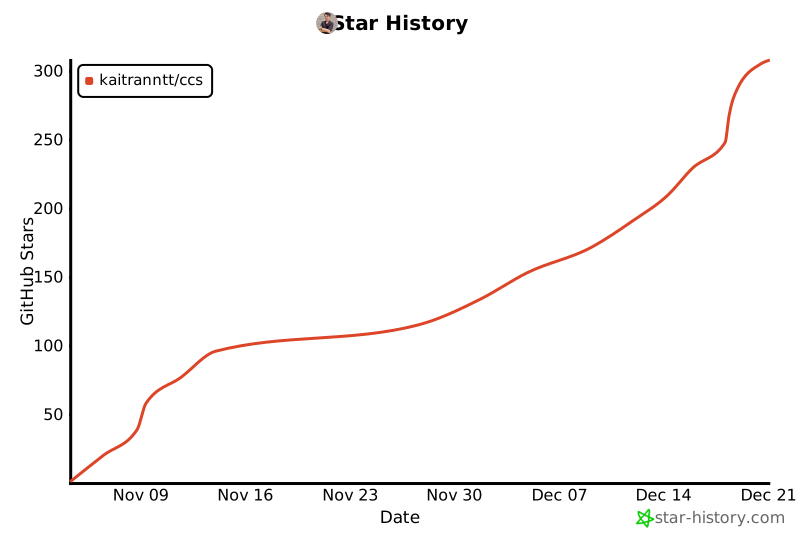
## Star History
[](https://www.star-history.com/#kaitranntt/ccs&type=date&legend=top-left)
---
**[ccs.kaitran.ca](https://ccs.kaitran.ca)** | [Report Issues](https://github.com/kaitranntt/ccs/issues) | [Star on GitHub](https://github.com/kaitranntt/ccs)