 Alex
de22be5a21
Alex
de22be5a21
Follow-up review pass over the embeddings branch.

- Fold an oversized header back into the body, and drop header duplication
  when it would leave under a quarter of the chunk budget. A header at or
  over max_tokens collapsed the body budget to one token, so a document
  became one chunk per body token, each still over the cap: a 95 KB file
  produced 20k chunks of 2563 tokens against a 1250 cap. Also clamp
  max_tokens to at least 1, as the strategy chunkers already do.
- Emit a header-only document as its own chunk. With no body piece to
  attach it to, splitting returned nothing and the document was dropped
  from the index with no error and no log line.
- Skip add_custom_model for a repository FastEmbed already ships. It
  rejects a name it knows, so configuring any of its ~30 built-ins
  (MiniLM, bge, e5, gte, ...) failed every embed call and every query.
- Decide "the user chose this model" by comparing against the field
  default rather than model_fields_set, which is true for anything read
  from .env. Every setup script has always written EMBEDDINGS_NAME, so an
  upgraded remote-embeddings install inherited mpnet's 384-token window
  and silently clipped ~80% off every chunk.
- Cut tiktoken splits at character offsets instead of decoding each token
  window. A multi-byte character straddling a boundary decoded to U+FFFD
  on both sides, destroying one character at roughly one boundary in five
  on CJK text -- including at the default max_tokens of 2000.
- Let the re-embed script open a FAISS index whose width does not match
  the configured model. That mismatch is the main reason to run it, and
  the error recommending the script was raised by the script itself, so
  the advice failed on every source.
- Re-embed graph_nodes.name_embedding when GraphRAG is enabled. Those
  vectors seed every traversal and share the chunk vectors' width, so a
  same-width model swap left the graph retrieving from the old space with
  nothing to report it.
- Prefetch the models before copying the application source, so editing
  any file no longer re-downloads ~780 MB of artifacts on every build.
- Mirror the setup.sh embedding menu into setup.ps1: granite default,
  legacy mpnet as an explicit option, and both engine flows updated.
  Windows users were otherwise stranded on mpnet with no granite path.
- Drop the unused EmbeddingsWrapper.tokenizer property.
DocsGPT 🦖
Private AI for agents, assistants and enterprise search
DocsGPT is an open-source AI platform for building intelligent agents and assistants. Features Agent Builder, deep research tools, document analysis (PDF, Office, web content, and audio), Multi-model support (choose your provider or run locally), and rich API connectivity for agents with actionable tools and integrations. Deploy anywhere with complete privacy control.



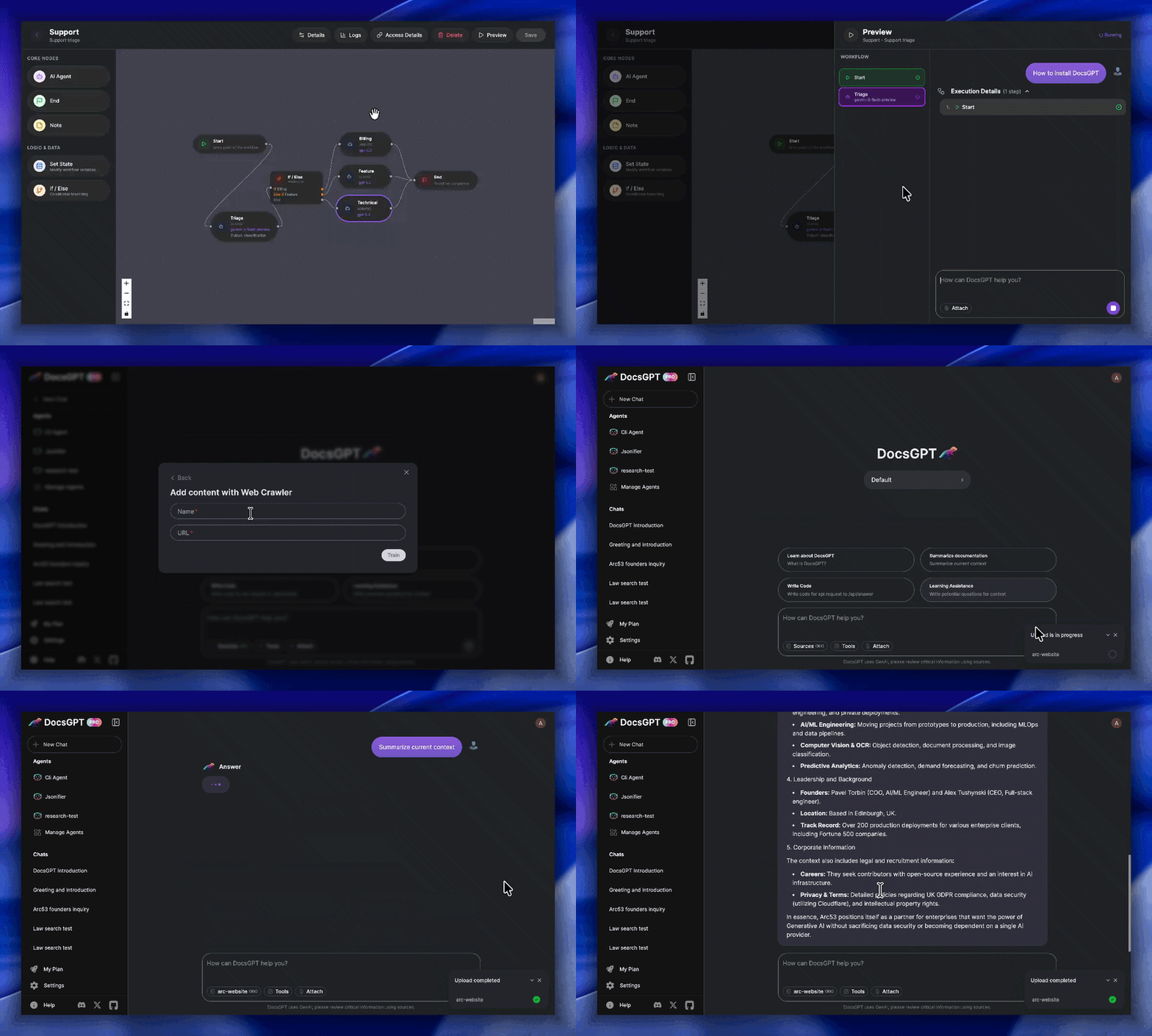
Key Features:
- 🗂️ Wide Format Support: Reads PDF, DOCX, CSV, XLSX, EPUB, MD, RST, HTML, MDX, JSON, PPTX, images, and audio files such as MP3, WAV, M4A, OGG, and WebM.
- 🎙️ Speech Workflows: Record voice input into chat, transcribe audio on the backend, and ingest meeting recordings or voice notes as searchable knowledge.
- 🌐 Web & Data Integration: Ingests from URLs, sitemaps, Reddit, GitHub and web crawlers.
- ✅ Reliable Answers: Get accurate, hallucination-free responses with source citations viewable in a clean UI.
- 🔑 Streamlined API Keys: Generate keys linked to your settings, documents, and models, simplifying chatbot and integration setup.
- 🔗 Actionable Tooling: Connect to APIs, tools, and other services to enable LLM actions.
- 🧩 Pre-built Integrations: Use readily available HTML/React chat widgets, search tools, Discord/Telegram bots, and more.
- 🔌 Flexible Deployment: Works with major LLMs (OpenAI, Google, Anthropic) and local models (Ollama, llama_cpp).
- 🏢 Secure & Scalable: Run privately and securely with Kubernetes support, designed for enterprise-grade reliability.
Roadmap
- Agent Workflow Builder with conditional nodes ( February 2026 )
- Research mode ( March 2026 )
- SharePoint & Confluence connectors ( March – April 2026 )
- Postgres migration for user data ( April 2026 )
- OpenTelemetry observability ( April 2026 )
- Bring Your Own Model (BYOM) ( April 2026 )
- Agent scheduling (RedBeat-backed) ( April 2026 )
- Notifications & conversation search ( May 2026 )
- Analytics & logs revamp with per-agent attribution ( June 2026 )
- OIDC / SSO login with SCIM provisioning & groups ( June 2026 )
- Admin dashboard & role-based access control (RBAC) ( June 2026 )
- Agent import / export ( June 2026 )
- Teams with team-scoped sharing & roles ( June 2026 )
You can find our full roadmap here. Please don't hesitate to contribute or create issues, it helps us improve DocsGPT!
Production Support / Help for Companies:
We're eager to provide personalized assistance when deploying your DocsGPT to a live environment.
Join the Lighthouse Program 🌟
Calling all developers and GenAI innovators! The DocsGPT Lighthouse Program connects technical leaders actively deploying or extending DocsGPT in real-world scenarios. Collaborate directly with our team to shape the roadmap, access priority support, and build enterprise-ready solutions with exclusive community insights.
QuickStart
Note
Make sure you have Docker installed
A more detailed Quickstart is available in our documentation
-
Clone the repository:
git clone https://github.com/arc53/DocsGPT.git
cd DocsGPT
For macOS and Linux:
-
Run the setup script:
./setup.sh
For Windows:
-
Run the PowerShell setup script:
PowerShell -ExecutionPolicy Bypass -File .\setup.ps1
Either script will guide you through setting up DocsGPT. Five options are available: using the public API, running locally, connecting to a local inference engine, using a cloud API provider, or building the docker image locally. The scripts will automatically configure your .env file and handle necessary downloads and installations based on your chosen option.
Navigate to http://localhost:5173/
To stop DocsGPT, open a terminal in the DocsGPT directory and run:
docker compose -f deployment/docker-compose.yaml down
(or use the specific docker compose down command shown after running the setup script).
Note
For development environment setup instructions, please refer to the Development Environment Guide.
Contributing
Please refer to the CONTRIBUTING.md file for information about how to get involved. We welcome issues, questions, and pull requests.
Architecture
Project Structure
-
Application - Backend Flask application.
-
Extensions - Integrations and widgets (e.g., Chatwoot, React widget).
-
Scripts - Miscellaneous utility scripts.
Code Of Conduct
We as members, contributors, and leaders, pledge to make participation in our community a harassment-free experience for everyone, regardless of age, body size, visible or invisible disability, ethnicity, sex characteristics, gender identity and expression, level of experience, education, socio-economic status, nationality, personal appearance, race, religion, or sexual identity and orientation. Please refer to the CODE_OF_CONDUCT.md file for more information about contributing.
Many Thanks To Our Contributors⚡
License
The source code license is MIT, as described in the LICENSE file.
This project is supported by:
